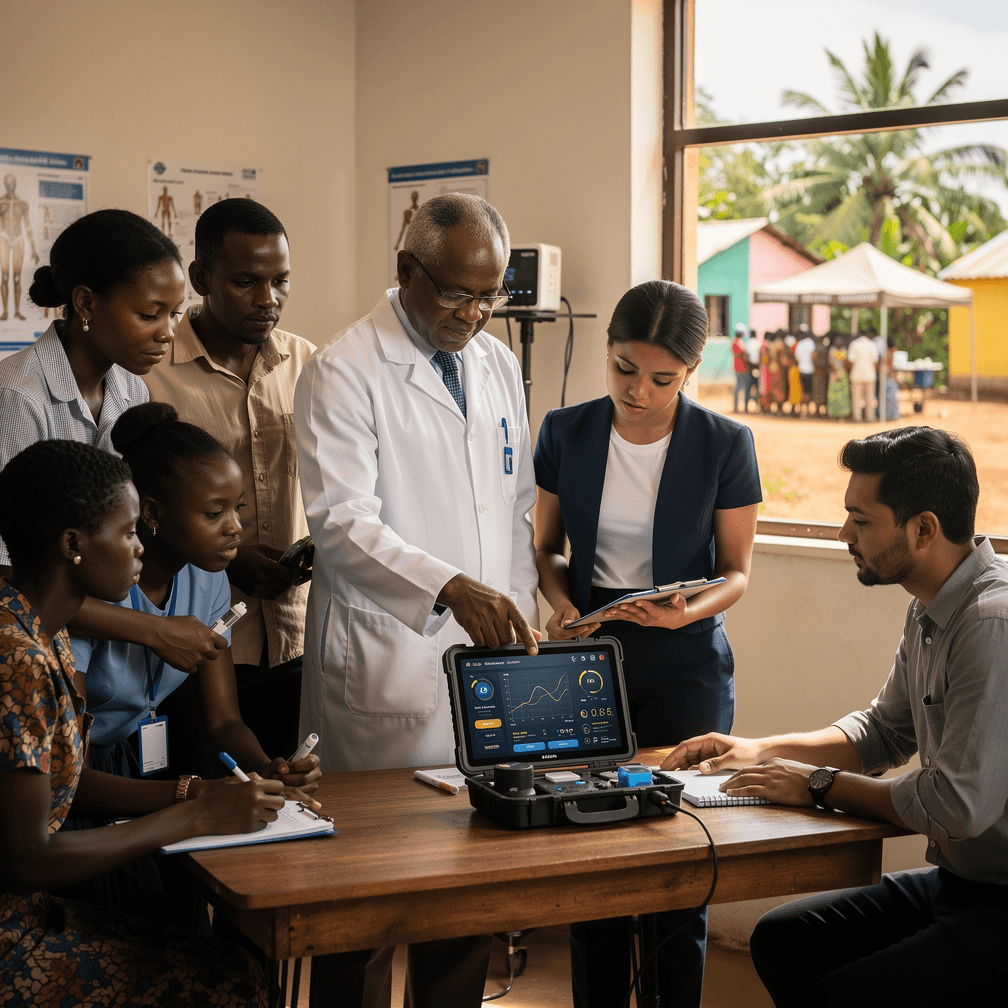
XeraCore is building an offline-first digital health platform designed for low-connectivity environments, with a long-term vision of delivering advanced diagnostic capabilities and high-precision, data-driven tools that improve healthcare accessibility and equity.
XeraCore is built to support a wide range of people and organisations working to improve healthcare access in underserved communities.
Whether you are a:
Our approach is collaborative, inclusive, and grounded in real-world environments:
You do not need to be a technical specialist to benefit from or engage with the platform.
XeraCore is an offline-first digital health platform and research programme designed to improve healthcare accessibility and continuity of care in low-connectivity environments. The platform combines secure data capture, digital health passports, longitudinal patient tracking, and geospatial intelligence to support frontline healthcare delivery while generating pseudonymised datasets for research and public health planning.
Alongside these operational capabilities, XeraCore is investigating how African language technologies, including automatic speech recognition (ASR) and text-to-speech (TTS), can improve accessibility for communities affected by language, literacy and connectivity barriers. Through real-world deployments, the programme aims to evaluate how offline-first speech technologies can support more inclusive healthcare experiences and help identify underserved populations and healthcare deserts.
Testing of the XeraCore app commences August 2026. Read in detail about our upcoming pilots below.
HEALTHBRIDGE-300 is a targeted clinical screening pilot implemented by SEB Foundation with PROTUS Health & Medical Manufacturing Solutions as a technical partner. HEALTHBRIDGE-300 is designed to provide critical health data and immediate care for 300 residents in the rural Jomoro Municipality. The initiative focuses on biochemistry and dental health, addressing a significant gap in specialist medical access within the Western Region. In conjunction with PROTUS' ASCEND-HEALTH pilot to train 5 women as textile engineers, our joint missions tackle economic and talent barriers through a healthcare approach. Upon project completion, PROTUS and the SEB Foundation will deliver a comprehensive data insights report to local health ministries, equipping government authorities with critical epidemiological trends and real-time regional statistics to drive evidence-based healthcare policies.
HEALTHBRIDGE-300 and ASCEND-HEALTH serve as the foundational pilot initiatives for the XeraCore platform. These deployments empower our team to field-validate our low-bandwidth functional prototype while simultaneously curating a robust linguistic corpus of Twi, Ewe, Fante, and Nzema clinical interactions across the Jomoro Municipality.
While Mooré is the dominant language (52%), integrating regional dialects like Dioula and Fula is critical to bypassing French-only administrative barriers, particularly in regions where the literacy rate averages 34.5%.
In partnership with PROTUS, we are designing a proposed 14-month mobile screening deployment across key sectors. Operating completely offline on rugged tablets, XeraCore will bring high-precision voice diagnostics directly to northern pastoralists and western commercial hubs. To overcome regional data scarcity, our engineering team is actively co-designing specialised baseline ASR pipelines built specifically to withstand low-resource West African infrastructure.
Shona (75%) and Ndebele (20%) form the linguistic pillars of Zimbabwe, alongside critical border languages like Tonga and Kalanga. While urban centers boast high literacy, rural areas face steep barriers, making intuitive, voice-driven clinical workflows a strict necessity.
XeraCore aims to architect a strategic hub-and-spoke clinical framework, bridging a specialised private urban center in Harare with rural clinics across Mashonaland East and Matabeleland. By routing advanced diagnostics and expert urban insights directly to remote field clinics, this network ensures that language barriers and geographic isolation no longer prevent underserved, native-language communities from receiving equitable, top-tier medical care.
In healthcare, data security is non-negotiable. To eliminate the vulnerabilities of cloud processing and protect sensitive patient information, XeraCore operates its speech recognition layers and geospatial dashboards 100% offline on local edge hardware. By processing all biometric and clinical data completely within the physical walls of the clinic, we ensure absolute compliance with cross-border regulations and regional data localisation laws.
Built to align seamlessly with Ghana's Data Protection Act (Act 843). XeraCore's localised processing ensures that patient interactions captured during the HEALTHBRIDGE-300 and ASCEND-HEALTH pilot initiatives are stored and curated entirely on-site. This allows clinical teams to build a robust local linguistic corpus without ever exposing sensitive community health data to external cloud networks.
Operating in remote environments and across mobile health screening units requires airtight data security that doesn't rely on a constant connection. By keeping all speech-to-text processing 100% offline on mobile tablets, XeraCore guarantees data safety for vulnerable nomadic and rural populations, maintaining strict institutional compliance even when care is delivered entirely on the move.
To navigate the stringent requirements of Zimbabwe's Data Protection Act, XeraCore completely bypasses cloud-based biometric storage. Our architecture ensures that clinical speech data and regional mapping insights generated across the Mutorashanga hub-and-spoke network stay strictly localised on local edge devices, maintaining total alignment with POTRAZ data sovereignty mandates.
Do you bring decades of expertise in spatial health equity, development research, and public health? Together, we can build a body of evidence that not only serves rural communities but informs global policy on mobile health interventions. Are you interested in partnering with us? Email us today at ourfuture@protushealth.com
Every technical decision behind XeraCore is guided by two fundamental questions:
Patient data is captured and securely stored locally on the device, allowing clinical activities to continue without an internet connection. Once connectivity becomes available, records automatically synchronise in the background. Future phases of XeraCore will evaluate how offline speech technologies can further improve accessibility in low-resource settings.
Through real-world health deployments, XeraCore is building and evaluating multilingual clinical datasets that reflect local dialects, healthcare terminology and oral traditions. Initial work focuses on Twi, with future investigation planned across languages including Nzema, Fante, Ewe, Shona, Ndebele, Tonga, Kalanga, Mooré, Dioula and Fula. This community-driven approach lays the foundation for more inclusive African language technologies in healthcare.
Beneficiary identities are pseudonymised at the point of capture using GDPR-aligned protocols. Once results have been reviewed and validated, beneficiaries receive secure access to their health summary and can download a portable digital health passport in PDF format. In parallel, pseudonymised clinical data contributes to secure research datasets, supporting public health insights and future healthcare innovation.
Every beneficiary receives a universally unique identifier (UUID) that securely links and tracks their health information across multiple visits, villages and healthcare workers. This persistent identifier supports continuity of care, longitudinal health monitoring and the generation of pseudonymised research datasets without unnecessarily exposing personal information.
Precise GPS coordinates are captured for each service encounter to generate a dynamic spatial data layer. This localised mapping automatically identifies structural service gaps and access inequities, transforming raw field data into actionable geospatial intelligence that supports evidence-based planning and resource allocation.
Field teams, clinicians and authorised programme users contribute to a shared, synchronised data ecosystem. Once connectivity becomes available, background synchronisation and conflict-resolution mechanisms maintain data integrity while supporting high-quality, pseudonymised research datasets.
Every data entry is timestamped, user-attributed, and entirely immutable to support clinical governance and academic reproducibility. This audit-ready infrastructure is continuously validated and improved by engaging local community language experts, translators, and front-line healthcare workers to build trusted, compliant systems.
XeraCore is built to scale. Beginning with a 300-person pilot in August 2026, our roadmap charts a clear path to global impact by 2028.
Foundation & Proof of Concept
As we transition into 2027, PROTUS Health is scaling from our initial pilot into a longitudinal engine for rural health equity. Our focus will be mapping the systemic barriers that create "health deserts" in hard-to-reach communities, with particular ambitions for Burkina Faso and Zimbabwe.
Ghana-Wide Expansion
International Deployment
XeraCore maintains separate, role-based portals for field agents, doctors, and researchers. Each portal is hosted on a dedicated secure web application.
Access your village roster, sync diagnostics, and log patient encounters from the field.
Coming SoonReview encrypted patient records, issue prescriptions, and close clinical referrals remotely.
Coming SoonAuthorised researchers can access pseudonymised datasets and longitudinal health records.
Coming SoonWe welcome partnerships from NGOs, research institutions, clinical networks, and technology collaborators who share our commitment to spatial health equity.